
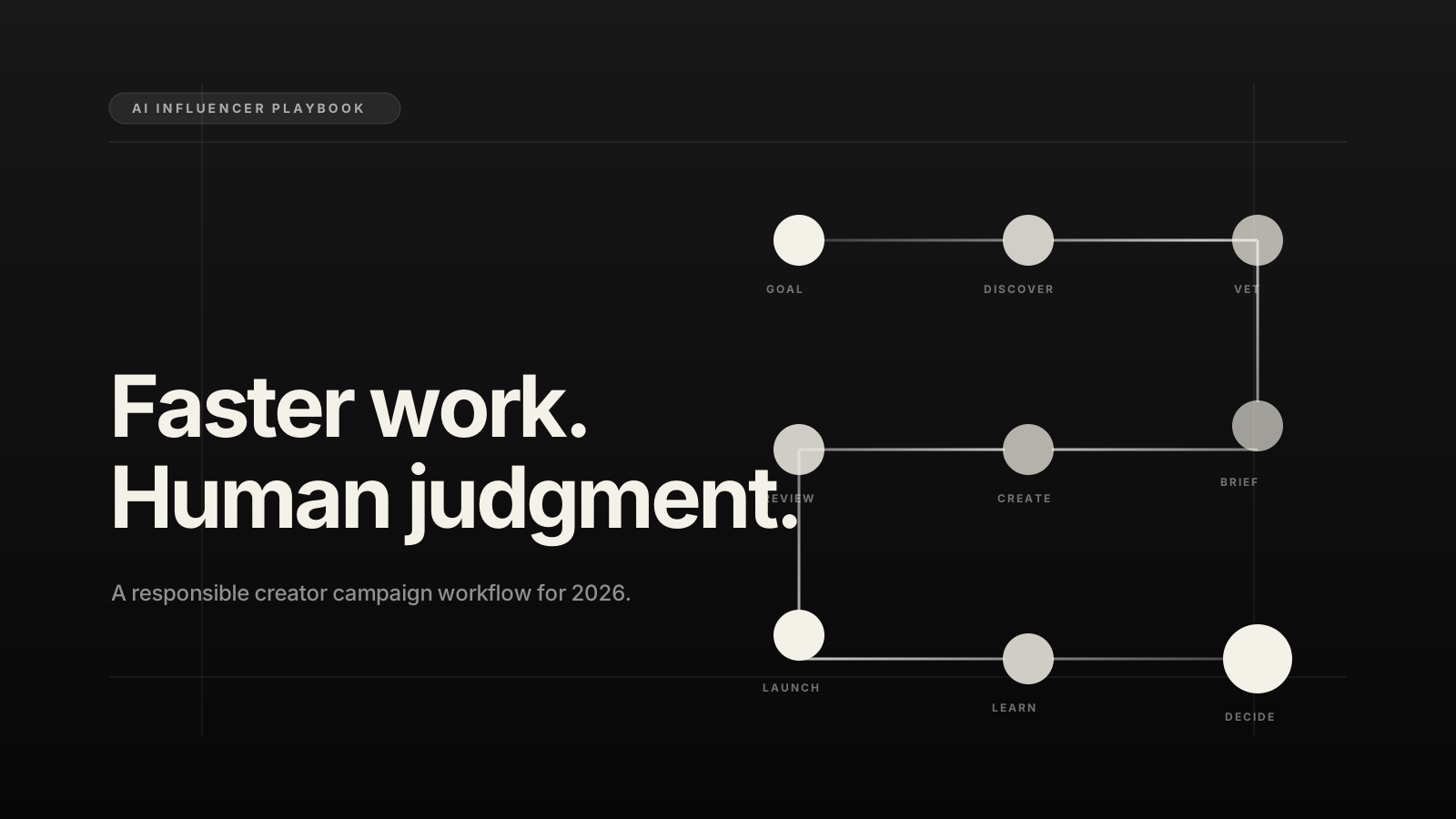
AI is useful in influencer marketing when it compresses research, organizes evidence, generates working variations, and helps teams learn faster. It becomes risky when it replaces consent, invents product claims, imitates a person without permission, hides synthetic content, or turns every creator into the same brand voice.
The operating principle for 2026 is human judgment at every irreversible point. Let software accelerate the reversible work—search, sorting, drafts, summaries, versions. Keep people responsible for creator selection, claims, contracts, likeness, disclosures, final creative, and budget decisions.
1. Define the campaign job in one sentence
Before opening a discovery platform, write the decision the campaign should influence. Examples include earning qualified awareness with AI developers, generating demos among marketing teams, creating usable product education, or testing which positioning angle creates the strongest response.
A clear job gives AI useful boundaries. Without it, discovery systems optimize for visible metrics and writing tools produce generic briefs. Add the target audience, platform role, offer, proof, conversion path, exclusions, and one primary measure.
- Audience: who must understand or act?
- Message: what should they believe after the content?
- Proof: what can the creator demonstrate or verify?
- Action: what should a qualified viewer do next?
2. Use AI to widen discovery, then narrow with evidence
Search with themes, audience descriptions, visual similarities, adjacent categories, and competitor mentions to find creators outside the obvious keyword list. Then score the shortlist against recent content, audience geography, genuine engagement, sponsor fit, safety, and operational reliability.
The human review should include at least ten recent relevant posts or videos. Read the comments. Check whether the creator corrects mistakes, how sponsorships are integrated, and whether the audience asks questions that match the product’s sales conversation. Remove anyone whose fit exists only in a model-generated summary.
3. Build a source-controlled brief
Give the team and the creator one approved source pack: product facts, demonstration access, claim boundaries, audience context, disclosure language, required links, timing, and known limitations. AI can turn that material into format-specific draft briefs, but every factual claim should trace back to the approved source.
Leave room for the creator to decide the hook, examples, language, and pacing. A creator brief should protect truth and campaign intent, not dictate a synthetic performance. Ask for an outline or concept checkpoint when the product is technical or regulated, then review the final asset only for agreed requirements.
- Never ask a model to invent a testimonial, result, customer quote, or personal experience.
- Mark required claims, optional context, and prohibited claims separately.
- Document whether AI-generated visuals, voice, translation, or likeness are allowed.
4. Use AI in production without erasing authenticity
Good production uses include transcription, captioning, noise cleanup, rough cuts, translation drafts, aspect-ratio versions, B-roll ideation, metadata, and locating short clips inside long-form footage. These tasks increase output without forcing the creator to surrender their point of view.
High-risk uses include cloning a creator’s face or voice, creating realistic events that never happened, presenting synthetic product use as personal experience, and publishing photorealistic alterations without the required platform disclosure. Permission and transparency need to be designed into the production plan, not added after export.
5. Treat disclosure as part of the creative
A sponsorship disclosure should be hard to miss and understandable where the endorsement appears. The FTC says a material connection includes payment, free or discounted products, employment, family, and other relationships of value. For video, a disclosure only in the description may not be enough; plan visible and spoken disclosure where appropriate.
AI disclosure is a separate question. YouTube requires disclosure when realistic content is meaningfully altered or synthetically generated, including making a real person appear to say or do something they did not. Its August 2026 update also explains how creators can review automatically applied labels. A synthetic-content label does not grant permission to use another person’s likeness.
6. Launch in a sequence that creates learning
Start with a small pilot group that covers distinct roles: one technical explainer, one workflow demonstrator, and one conversation or distribution voice. Stagger publication so early questions can improve later briefs. Reuse the strongest creator asset only if the contract includes the correct usage and paid-media rights.
AI can summarize comments, cluster objections, and compare creator outputs, but a campaign owner should read representative responses and watch the content. Context matters: repeated confusion can signal a product or positioning problem, while thoughtful questions may be more valuable than a large volume of shallow engagement.
7. Close the loop with a decision
Measure the direct layer—clicks, trials, sales, demo requests—and the assisted layer—branded search, return traffic, sales mentions, useful comments, and reusable creative. Keep the source data, campaign notes, and qualitative review together so the next shortlist starts with evidence.
The report should end with one of three decisions: scale a proven creator and angle, refine a promising experiment, or stop a weak combination. A summary without an allocation decision is documentation, not campaign intelligence.
- Scale when the same signal repeats across compatible creators or assets.
- Refine when audience quality is strong but the offer, message, or conversion path underperforms.
- Stop when fit is weak, claims are unsafe, execution is unreliable, or the cost cannot be justified.
Key takeaway
The best use of AI in influencer marketing is not replacing creators. It is removing low-value work while keeping people accountable for truth, consent, creative judgment, disclosure, and investment decisions.
Related reading
Tools
Best AI Marketing Tools for Creator Campaigns in 2026
The useful question is not which AI tool is best. It is which tool removes the weakest step in your creator marketing workflow without adding another disconnected dashboard.
Creator Lists
Biggest Social Media Influencers in August 2026
Cristiano Ronaldo, Khaby Lame, MrBeast, and Elon Musk lead the largest individual audiences by platform—but reach alone is not a creator strategy.
Need help running this properly?
Contact InfluencersX if you need creator sourcing, rollout support, or a cleaner performance readout.